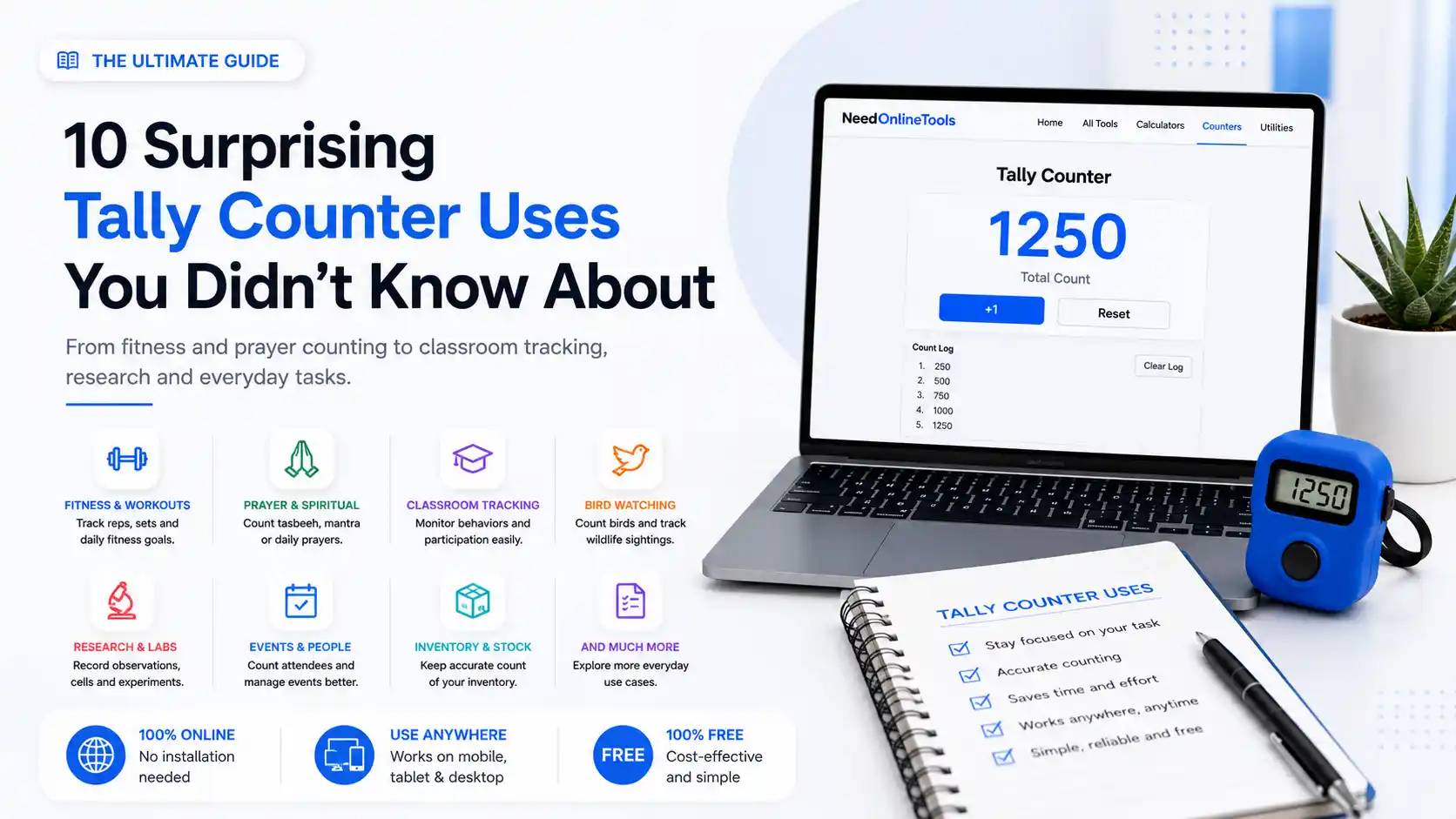
If you search "what is a tally counter used for," you will find the same three answers repeated everywhere: counting people at events, tracking gym reps and managing inventory. Those are valid uses. But they are only the beginning.
We built the tally counter at NeedOnlineTools, and over time our users have shared how they put it to work in ways that genuinely surprised us. From counting knitting rows mid-pattern to tracking prayer repetitions during a commute to recording tadpole movements in a school biology study, the range of real-world uses is far wider than most listicles acknowledge.
A tally counter removes the mental load of counting. When you are focused on a task like leading a workout class, observing birds in the field or teaching a lesson, splitting your attention to track a number in your head causes mistakes. A single button press keeps the count accurate without breaking your concentration.
Whether you use a physical handheld device or a free online tally counter on your phone, the core function is identical: click once, add one. That simplicity is exactly what makes it powerful across dozens of situations most people never consider.
Here are 10 tally counter uses worth knowing, with practical tips for each one.
1. Fitness Rep Counting During Workouts
This is the most common personal use of a tally counter, and for good reason. When you are mid-set doing push-ups, squats or pull-ups, counting in your head while also focusing on form leads to two problems: losing your count or losing your form. One always suffers for the other.
A tally counter placed beside you, or held in one hand for single-arm exercises, solves this completely. Each completed rep gets one click. The counter holds the total so your brain can focus entirely on the movement.
How to get the most from it:
For a goal like 100 push-ups spread across multiple sets, do not reset between sets. Let the counter run from 0 to 100 across all sets combined. When it reads 100, you are done regardless of how many sets it took. This removes the mental overhead of tracking "I did 20, then 18, then 17, so I need 45 more" mid-workout.
Personal trainers use the same method to track client reps across a full session, giving them accurate data for programming future workouts without relying on memory. A trainer managing three clients in a circuit class might keep one counter running per client, resetting only at the start of a new session.
One of our users, a personal trainer based in Manchester, told us: "I used to write rep counts on my hand in marker. Now I just keep the counter open on my phone on the bench. My clients think it's more professional and I stopped losing track completely."
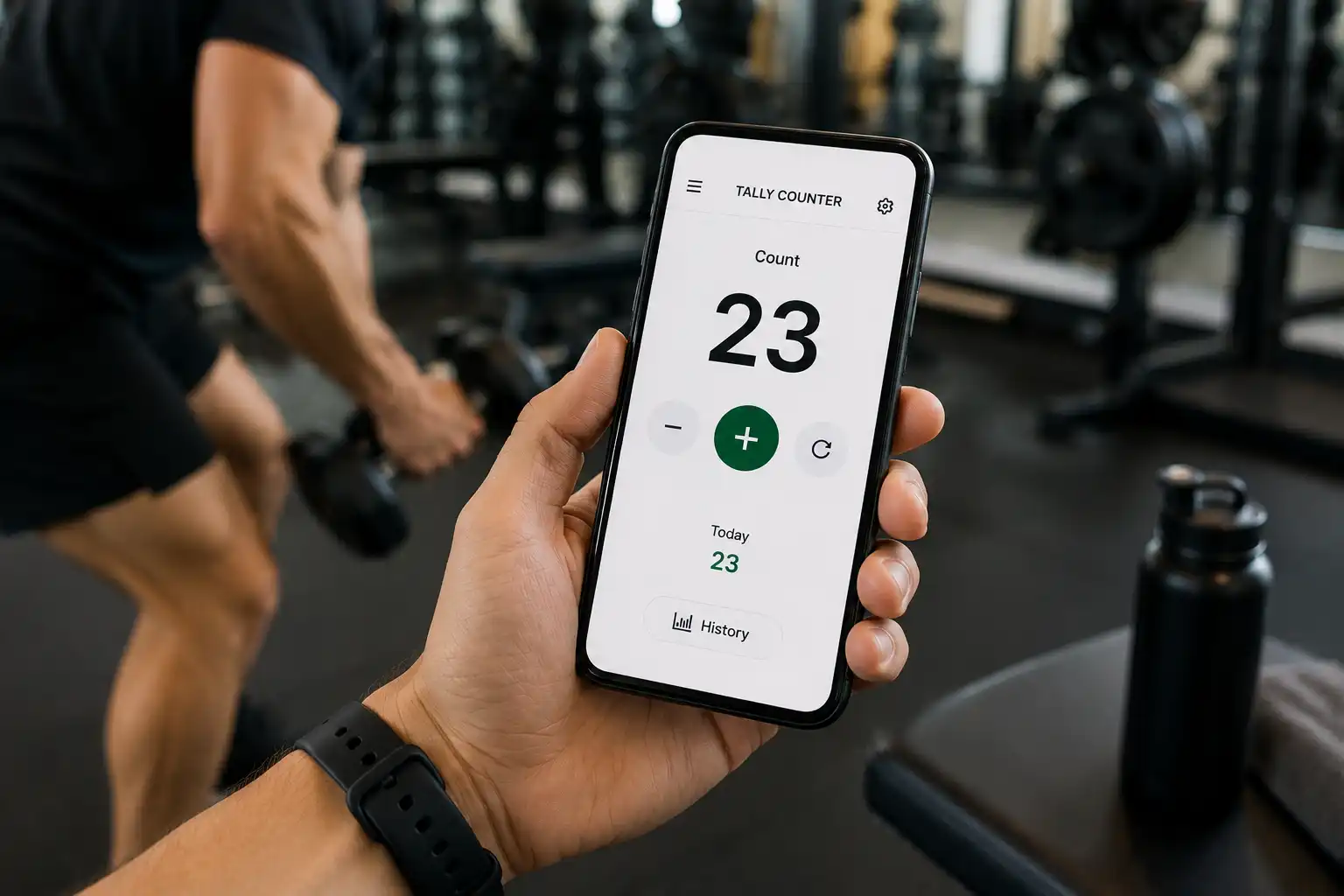 Person holding a phone showing a tally counter at 23 reps during a workout
2. Prayer and Spiritual Practice (Tasbeeh / Dhikr)
One of the oldest and most widespread tally counter uses is counting repeated prayers. In many religious traditions, specific prayers or mantras are repeated a precise number of times. Thirty-three, 99 and 108 are among the most common targets.
Traditionally this was done with prayer beads. A digital tally counter offers an alternative that is always available on the device already in your pocket.
Who uses it this way:
- Muslims counting tasbeeh after salah. The post-prayer sequence involves 33 repetitions of SubhanAllah, 33 of Alhamdulillah and 34 of Allahu Akbar totalling 100.
- Sikhs tracking repetitions of Waheguru or the Mul Mantar
- Hindus counting mantra repetitions (japa) toward a daily or monthly target
- Buddhists counting nembutsu recitations or mala rounds
- Christians counting rosary prayers through each mystery
The advantage of a digital counter over physical beads in a noisy or distracting environment such as a commute, a busy household or a hospital waiting room, is that the number is visible at a glance. You cannot lose your place the way you can with beads if your hand shifts unexpectedly.
For a deeper look at how this fits into daily practice, the Wikipedia article on dhikr covers the tradition across different schools of Islamic practice.
3. Classroom Behavior Tracking for Teachers
Teachers deal with a constant stream of events throughout a lesson: student responses, interruptions, off-task moments and positive behaviors. Trying to track these mentally while also teaching is not realistic.
A tally counter gives teachers a quiet, discreet way to record behavioral data in real time without stopping the lesson.
Practical classroom applications:
The last column matters more than most teachers realize. Research published in the Journal of Positive Behavior Interventions found that teachers who tracked their own praise delivery increased positive feedback to students significantly within two weeks, simply because counting made them aware of how infrequently they were doing it. The counter created accountability.
Special education teachers and teaching assistants use behavior tracking frequently for formal BIPs, where documentation of specific behaviors is legally required to measure intervention progress. A single click counter running during a 30-minute observation session produces far cleaner data than hash marks on paper.
Tip: Run two counters simultaneously. Use one tab for positive behaviors and one for negative. The ratio at the end of the session tells you more than either number alone.

A teacher holding a phone with a tally counter visible while monitoring classroom activity
4. Bird Watching and Wildlife Surveys
Field researchers, ornithologists and serious birdwatchers have used tally counters as standard equipment for decades. The British Trust for Ornithology's Breeding Bird Survey, which has run continuously since 1994, uses trained volunteers carrying counters to record species at fixed observation points across more than 3,000 sites in the UK every year. This is not a niche hobby method; it is professional scientific methodology.
The tool lets you record species sightings accurately without fumbling with paper and pen. When a flock passes, you click once per individual. Your hands stay free for binoculars and your count stays accurate even in cold weather when writing is impractical.
Scientific survey uses:
- Point counts: recording how many individuals of each species are seen in a fixed time period at a fixed location
- Transect surveys: counting animals seen while walking a measured route
- Breeding bird surveys: tracking species presence and abundance across seasons
- Waterbird censuses at lakes, estuaries and reservoirs
- Roadkill monitoring along fixed road segments
Wildlife biologists also use counters when reviewing camera trap footage, clicking through video and counting each individual animal that passes a sensor point during a recording period.
For citizen science participants, platforms like eBird, which has collected over 1.7 billion bird observations globally, recommend using a counting method during observations. A tally counter on your phone while birding feeds directly into the kind of accurate data these databases need.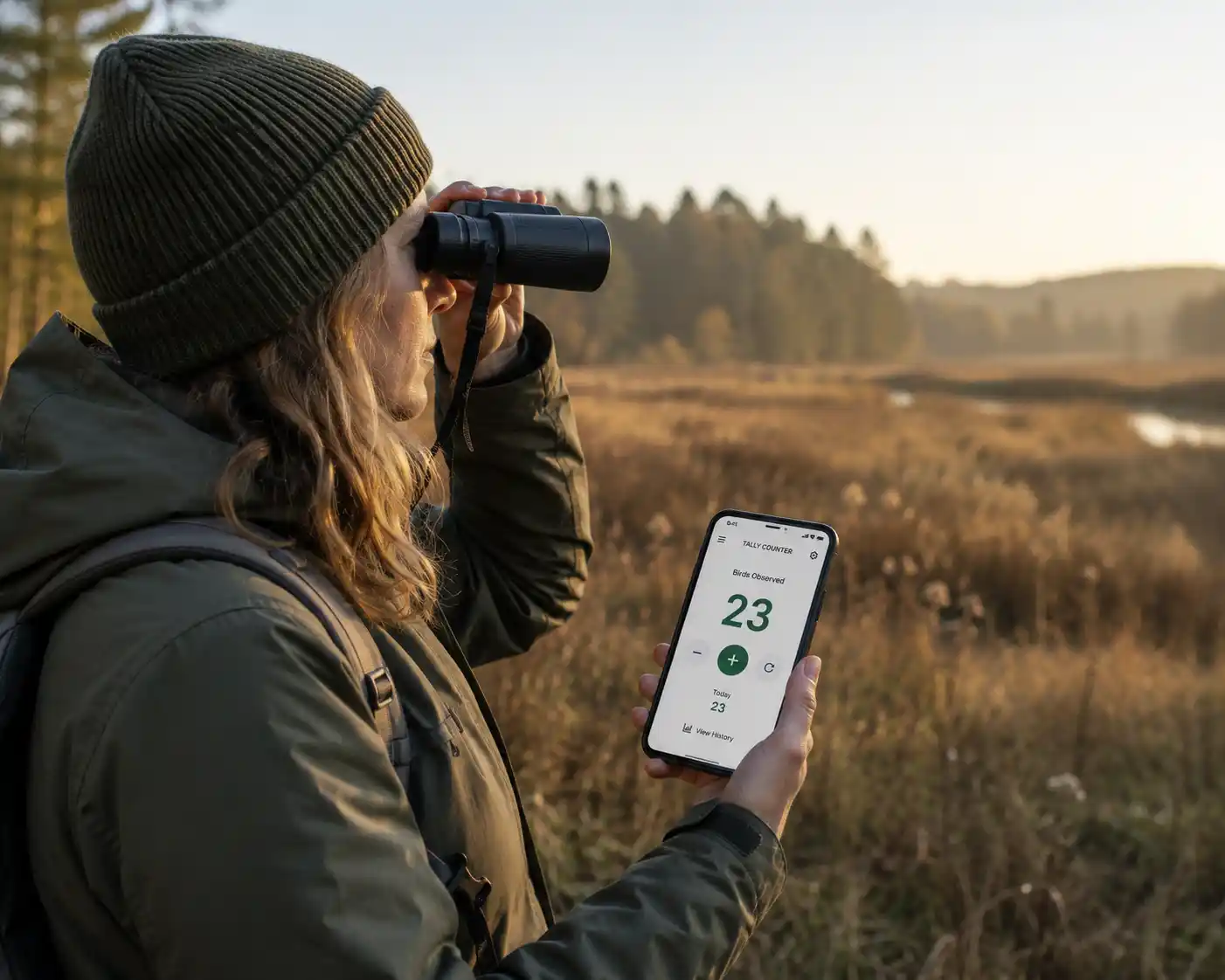
A birdwatcher using binoculars while holding a phone with a tally counter to record species sightings
5. Habit Tracking and Daily Goals
One of the most underrated tally counter uses is personal habit tracking. Assign a daily click target to a behavior you want to build or reduce, and use the counter to stay honest with yourself.
Building positive habits:
- Click each time you drink a glass of water (target: 8 per day)
- Click each time you stand up from your desk (target: once per hour for 8 hours)
- Click each time you read one page of a book
- Click each time you do 10 deep breaths or a mindfulness pause
Reducing unwanted habits:
- Click each time you pick up your phone without a reason
- Click each time you use a filler word (um, like, basically) during a practice presentation
- Click each time you interrupt someone in conversation
The counter creates awareness that willpower alone cannot. Research published in Frontiers in Psychology (2019) on self-monitoring and behavior change found that people who used a simple counting method to track target behaviors showed significantly stronger habit formation than those who relied on memory or intention alone. The act of counting makes the behavior conscious rather than automatic.
One of our users described this effect directly: "I started counting how often I picked up my phone for no reason. On the first day I hit 73 before noon. Just seeing that number made me put the phone face-down on the desk. I didn't need an app or a screen time limit. Just the count."
That is the mechanism. The number creates feedback. The feedback changes behavior. The tool does not need to be complex to be effective.
6. Quality Control on Production Lines
Manufacturing and production environments require accurate defect tracking, unit counting and batch verification. A tally counter is a standard tool in these settings because it requires no software, no setup and no training.
To understand why accuracy matters here: a production line running at 60 units per minute over an 8-hour shift produces 28,800 units. A 1% manual counting error rate, which is conservative for mental counting under noise and time pressure, means 288 miscounted items. That is enough to fail a batch audit or ship an incorrect quantity to a major client.
How production teams use it:
- Counting units completed per shift against a daily target
- Tracking defective items removed from a batch (click per defect)
- Verifying package contents at packing and sealing stations
- Counting completed inspections per hour against a throughput target
A digital online tally counter works particularly well in quality review contexts. A supervisor checking production footage on a laptop can click through video and count defects without specialized software, logging totals for each 10-minute segment of footage reviewed.
The key advantage is that the counter does not require the operator to look away from the work being inspected. One thumb on the button, eyes on the product.
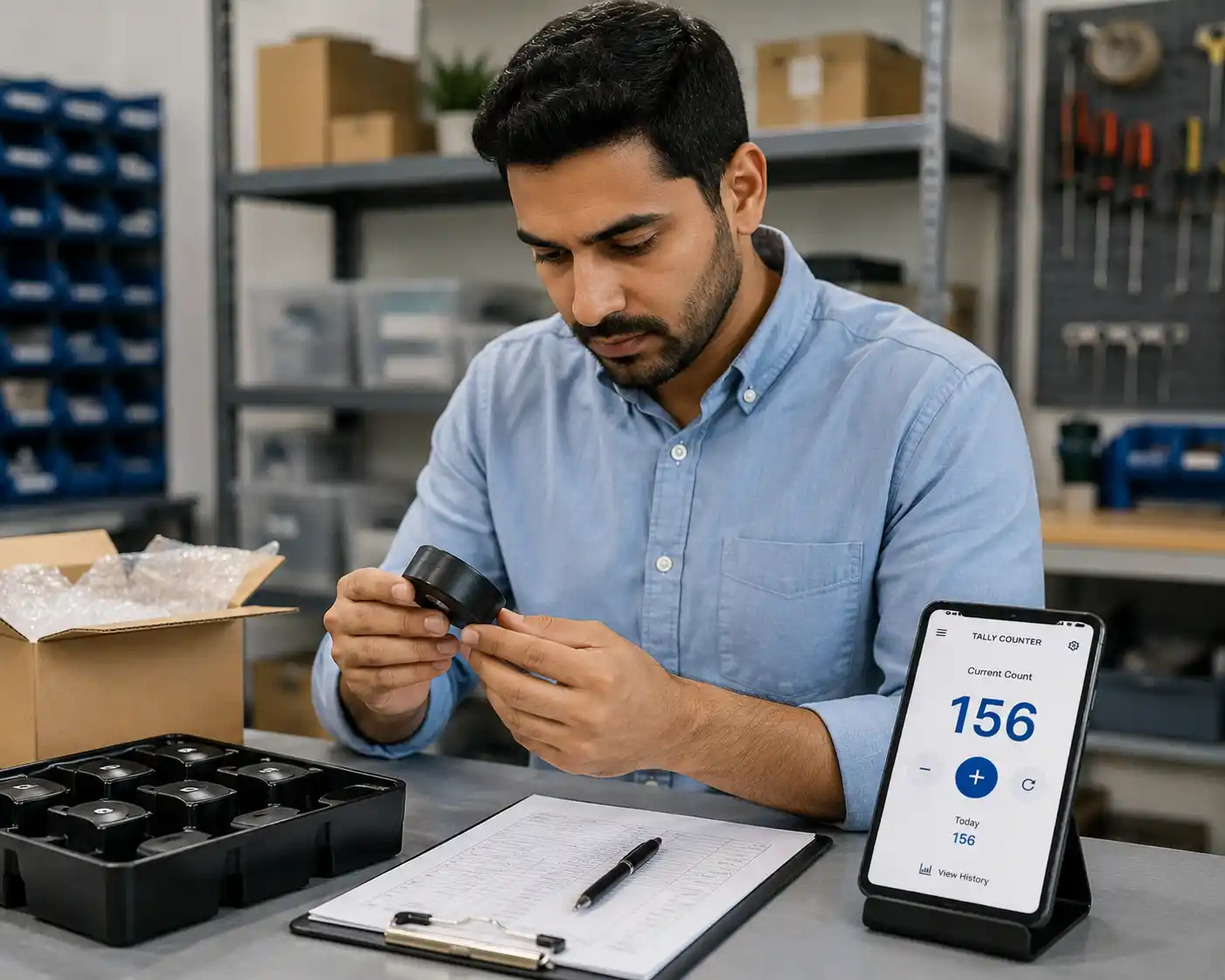
A quality control worker at a production station with a tally counter on a tablet beside them
7. Traffic and Pedestrian Studies
Urban planners, traffic engineers and small business owners all conduct manual counts to understand how people move through an area. Tally counters are the standard field tool for this work.
Here is exactly how a basic pedestrian count works using a free online counter:
- Open the NeedOnlineTools tally counter on your phone
- Set a 15-minute timer on a second device or a watch
- Stand at your observation point such as a shopfront, a pavement crossing or a gate
- Click once each time a person passes in your target direction
- At 15 minutes, note the total
- Multiply by 4 to get an estimated hourly footfall figure
- Repeat at different times of day (9am, 12pm, 3pm, 6pm) to build a daily pattern
Doing this across four time windows gives a business owner real data to answer questions like: when is the busiest hour? Is Saturday morning or Saturday afternoon busier? Does the shopfront on the high street get more traffic than the unit around the corner?
For formal traffic studies, a two-person team uses two counters simultaneously, one for each direction of flow, to get net movement through a point. Data collected this way feeds directly into council assessments for pedestrian crossings, cycle lanes and junction redesigns.
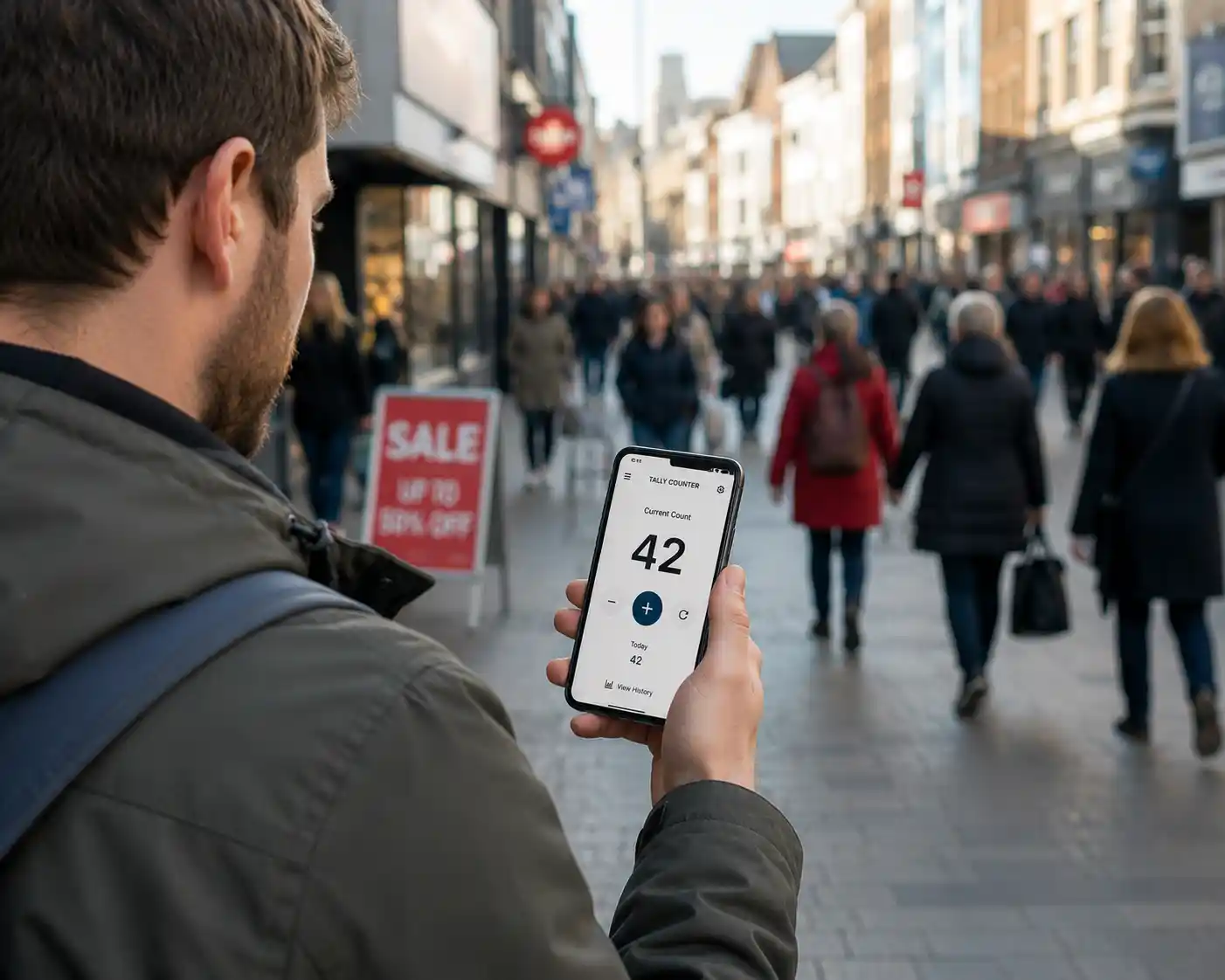
A person standing on a busy high street holding a phone with a tally counter to record pedestrian traffic
8. Counting Laps and Lengths in Swimming
Swimmers, triathletes and open water swimmers regularly use tally counters to track laps or pool lengths. Mental counting breaks concentration during serious training, and losing your lap count partway through a session, particularly during a long endurance set, is a common frustration that disrupts the whole session.
Poolside counters on a phone work well for steady-state sessions: tap after each length, glance at the total when you touch the wall, push off again. The interaction takes under a second.
Training applications:
- Tracking total lengths in a high-volume distance session
- Counting interval reps in structured swim training (e.g., 20×50m)
- Keeping score in team water polo drills or relay sets
- Counting laps in triathlon brick sessions on short pool courses
Coaches counting lengths for multiple swimmers across lanes will often assign one counter per lane to a team manager, who clicks each time a swimmer completes a length. At the end of the set, every swimmer has an exact rep count without anyone needing to communicate mid-water.
For open water swimmers doing laps of a buoy course, a waterproof mechanical counter such as the Sportcount Lap Counter, which attaches to a finger and survives repeated submersion, handles conditions where a phone is not practical.
9. Audience Polling and Show-of-Hands Counting
Meeting facilitators, event hosts and conference moderators regularly need to count votes or responses from a group. Asking for a show of hands and trying to count quickly across a room of 40 or 80 people while also managing the discussion is unreliable and often contested.
Consider a company all-hands meeting with 60 attendees voting on a policy change. Manual counting by scanning the room takes 20 to 30 seconds and regularly produces disputes. "I counted 32." "I got 29." With a counter, the facilitator or an assistant clicks once per raised hand and reads the result instantly. The number is unchallengeable because it was recorded click by click.
Where this applies:
- Company meetings counting votes on decisions or priorities
- School assemblies counting responses to a question
- Panel discussions tracking audience preference between options
- Focus groups recording agreement or disagreement with a statement
- Church services or community gatherings tracking attendance mid-event
For remote meetings, a moderator can count thumbs-up reactions or raised-hand emoji responses in a video call using the counter in a browser tab alongside the call. One hand manages the call, one finger clicks the counter.

Meeting facilitator holding a tablet with a tally counter while attendees raise hands to vote
10. Counting Rows and Repeats in Knitting and Crochet
Knitters and crochet crafters use counters to track row counts and stitch repeats, particularly for complex patterns where losing track means having to count backwards through the work to find your position.
The most common scenario is a cabled pattern where you knit a set number of plain rows between each cable crossing. Miss the count by one row and the cable crosses too early, resulting in a tight, compressed cable, or too late, giving a loose, sloppy cable that ruins the texture. For an experienced knitter, getting this wrong on row 3 of a 40-row pattern section is the kind of error that requires undoing hours of work.
A click at the end of each row removes that risk entirely. The counter holds the row count and the knitter's brain holds the pattern. They do not compete.
Where crafters use it:
- Tracking rows in a pattern section before a cable crossing or color change
- Counting stitch repeats when working a textured or lace pattern
- Recording rounds in circular knitting (hats, socks, cowls)
- Tracking increase and decrease points in shaping sections
A thread on r/knitting noted this exact frustration: "I've frogged the same section three times because I keep losing count at row 6 of an 8-row repeat. My hands are busy, I can't use a pen and I keep getting interrupted." The top answer was a tally counter on a phone. Click with a knuckle if your hands are occupied.
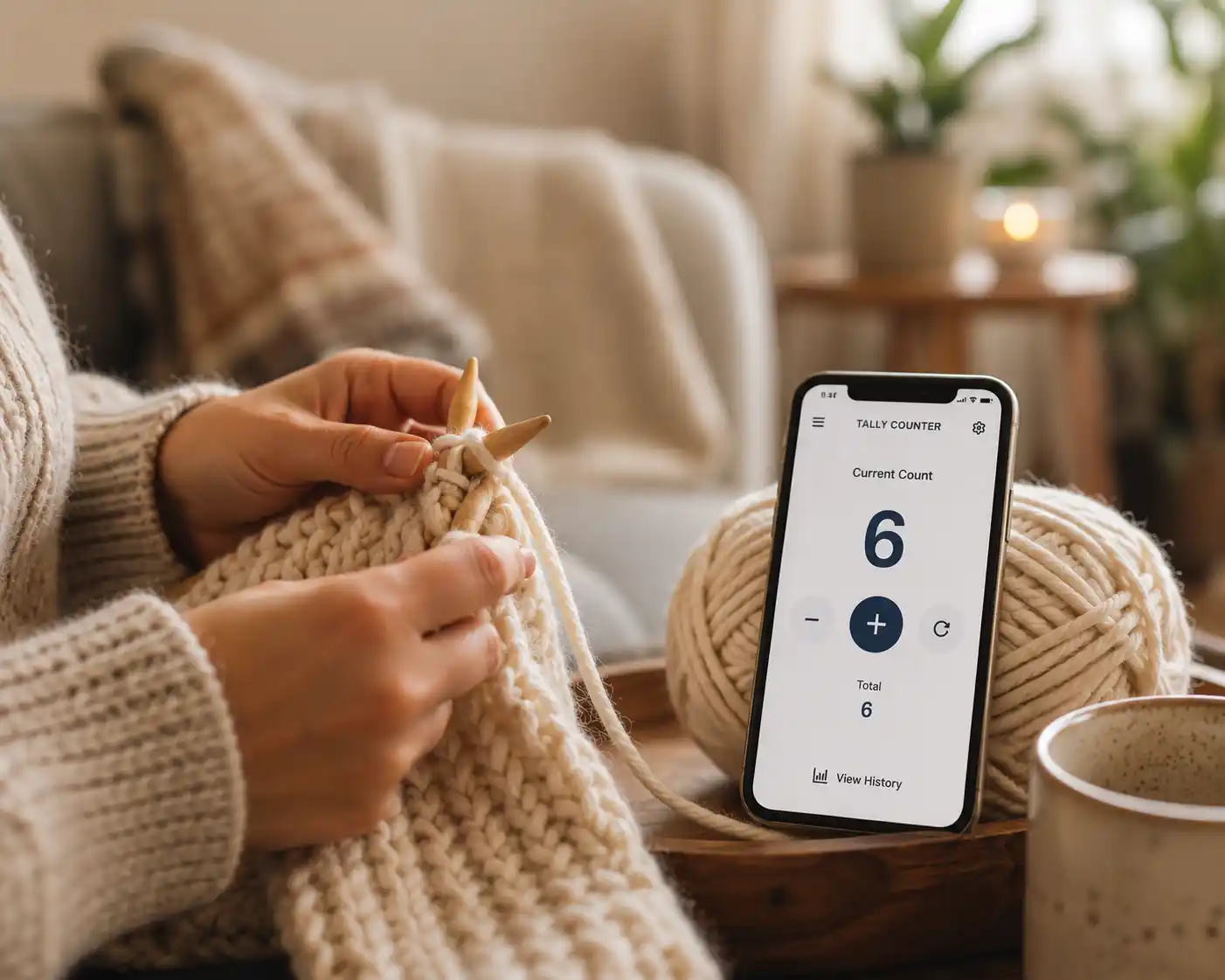
Knitting hands with chunky yarn and a smartphone tally counter showing the number 6 propped nearby
How to Get the Most From Any Tally Counter
A few habits make tally counting more reliable regardless of what you are counting.
Reset before every session. A carry-over number from a previous count is the most common source of inaccurate data. Start every new task from zero.
Count one thing at a time. If you need to track two variables such as correct versus incorrect answers or vehicles going left versus right, use two separate counters rather than alternating between mental notes and one counter.
Set a target before you start. Most online tally counters, including the NeedOnlineTools version, let you set a target number. Knowing you need to reach 100 before stopping makes the count purposeful and tells you exactly when you are done.
Keep the counter one tap away. The value of a tally counter is instant access. If reaching it takes more than one second, you will start counting mentally instead and that defeats the purpose.
Which Tally Counter Should You Use?
For everyday tasks like fitness, classroom use, habit tracking, spiritual practice and light data collection, a free online tally counter on your phone is the fastest option. Nothing to carry, charge or set up.
The NeedOnlineTools tally counter works on any device, lets you set a target number, includes a step feature for counting in increments larger than one and keeps an activity log so you can review your count history. It is completely free with no account required.
For outdoor fieldwork like wildlife surveys, swimming or traffic counts in wet conditions, a waterproof mechanical tally counter is worth buying. Most cost between £5 and £15 and last for years.
For teams where multiple people need to count simultaneously and results need to be logged centrally, purpose-built people-counting apps or dedicated hardware make more sense.
Summary
A tally counter is a deceptively simple tool. One button, one number. And yet the range of tally counter uses spans fitness, education, science, manufacturing, spirituality, crafting and daily habit building.
The ten uses covered in this guide:
- Fitness rep counting: track sets and reps without mental overhead
- Prayer and spiritual practice: digital alternative to physical beads
- Classroom behavior tracking: real-time data without pausing the lesson
- Bird watching and wildlife surveys: the method used by professional ornithologists
- Habit tracking: counting creates awareness that willpower alone cannot
- Quality control on production lines: eliminate costly counting errors
- Traffic and pedestrian studies: a 15-minute count gives actionable footfall data
- Swimming laps: never lose your count mid-set again
- Audience polling: instant, unchallengeable vote counts
- Knitting and crochet: row counts handled mechanically, pattern handled mentally
If your task involves counting something that happens repeatedly, a tally counter makes it faster and more accurate. Start with the free online version. No setup, works immediately on any device.
For more counting guides, read how to keep an accurate count in busy, crowded situations or learn how businesses use online tally counters for inventory and stock management.