You have tried habit tracking apps before and deleted every single one of them within two weeks. The setup took too long, the interface got in the way and checking in started to feel like another task on an already long list. Here is the thing: the tool was the problem, not you.
A free tally counter online fixes this by removing every layer of friction between you and the act of counting. No account. No streak pressure. No notifications. Just a number that goes up every time you do the thing you said you would do. By the end of this guide you will understand exactly why simple counting outperforms complex habit apps for most people, how to set up a working habit system in under two minutes and which habits are best tracked by count versus which ones need a different method entirely.
What this guide covers:
- Why friction is the real reason most habit systems fail
- What the science says about repetition, counting and behaviour change
- How to use a tally counter online for six specific habit types
- A practical setup guide you can use today in under two minutes
- The difference between counting-based habits and time-based habits
- Why most habit tracking apps add friction instead of removing it
The Real Reason Habit Apps Fail Most People
The App Store has hundreds of habit tracker apps. A 2026 review of the best-rated ones found one consistent pattern across almost all of them: they get downloaded, used for about a week and then abandoned. The download numbers are impressive. The retention numbers are not.
The research explains why. A 2024 systematic review published in PMC that covered 20 separate studies and 2,601 participants found that friction plays a significant role in whether a habit forms or dies. Making a behaviour easy and automatic helps people decrease the resistance that stops them from repeating it. Making it complicated or multi-step has the opposite effect.
Most habit apps are complicated by design. They want you to log your mood, your streak, your notes and your completion rating for each habit. They send you push notifications that eventually get ignored or turned off. They have premium plans that lock features behind a paywall. All of that adds friction. And friction is the single biggest enemy of a new habit.
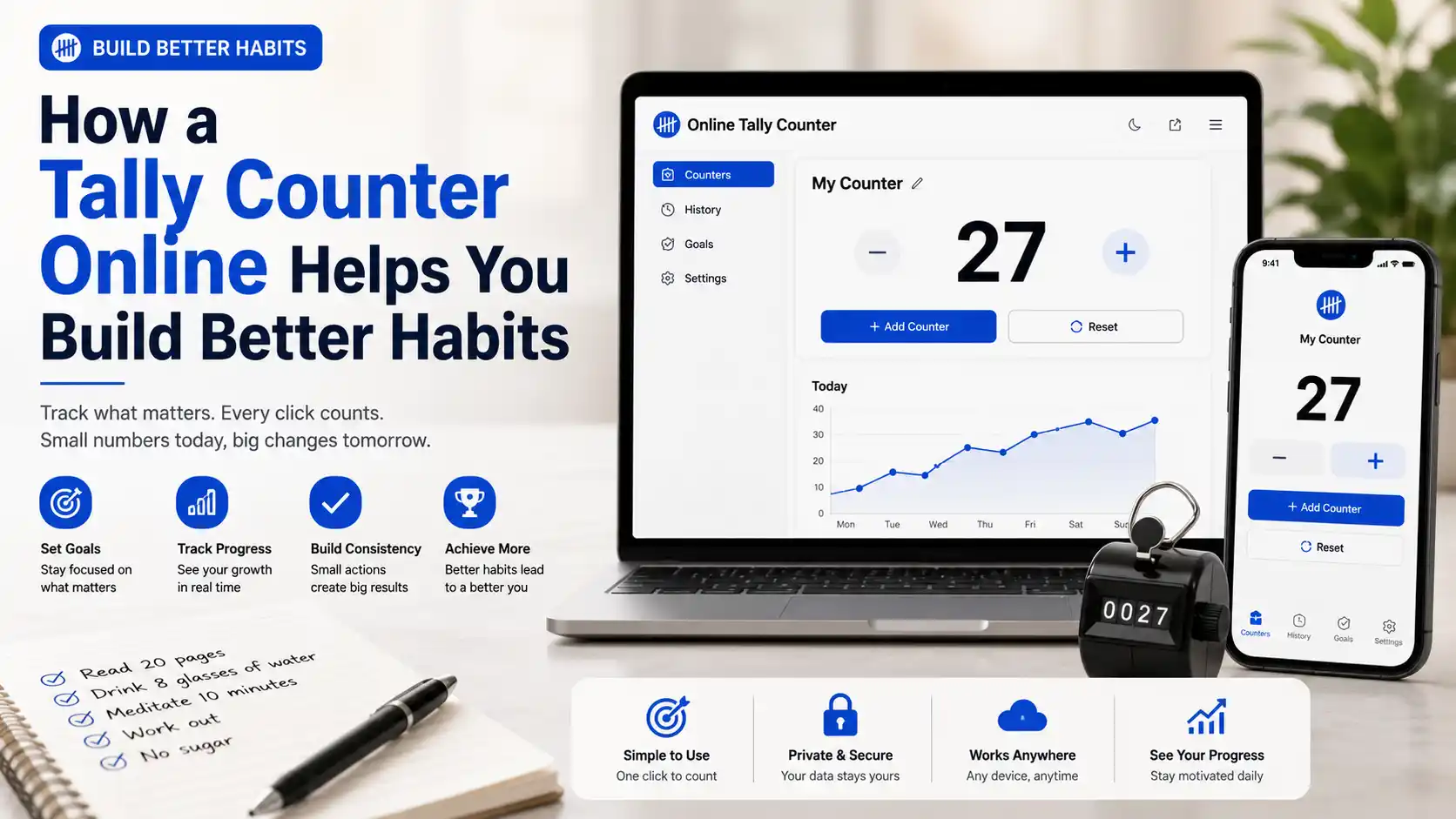
A tally counter online removes every one of those layers. You open a browser tab. You name your counter whatever you are tracking. You tap plus once per rep. The number goes up. That is the whole system.
The same 2024 research found that habits participants chose themselves, actually enjoyed and repeated consistently, especially in the morning, tended to form faster than ones assigned or heavily structured from outside. A counter that adapts to whatever you personally decide to track fits that pattern exactly.
What Counting Actually Does to Your Brain
Tracking a number creates a feedback loop. Every time you tap the counter and see the number increase, you get a small signal that the behaviour happened. Over time that signal becomes part of the habit loop itself.
The habit loop works like this: a cue triggers a routine and the routine produces a reward. The reward is what the brain uses to decide whether to repeat the routine next time. For a habit to stick, the reward needs to feel real and immediate. Watching a number go from 7 to 8 is a real, immediate reward. It is small but it is visible and it is tied directly to the action you just completed.
Dopamine, the brain chemical that connects actions to rewards, plays a central role in this. Research on habit formation consistently finds that dopamine is released not just when you get a reward but in anticipation of it. Once a habit is partly formed, the brain starts releasing dopamine when it sees the cue, before the behaviour even happens. A visible counter you check regularly becomes part of that anticipatory loop.
A 2025 study published in the Journal of Applied Psychology found that habit stacking, where a new behaviour is attached directly to an existing one, increased success rates by 64 percent compared to building standalone habits. A tally counter online works naturally with habit stacking because you can open the tab as part of a sequence you already do, such as opening your browser in the morning, completing the habit, clicking once and moving on.
Research from 2024 also found that it takes a median of 59 to 66 days for a new habit to feel established, with the full range running from as few as 4 days up to 335 depending on the person and the habit. There is no universal number. But consistency of repetition in a stable context is the factor that shows up across every study. A counter gives you the consistent context. The number tells you whether you showed up.
Six Habits That Work Perfectly With a Tally Counter Online
Not every habit is best tracked by counting. Time-based habits like meditating for 20 minutes or exercising for 30 minutes are better tracked with a timer. But completion-based habits, things you either do or do not do in a discrete act, are exactly what a counter is designed for.
Here are six types that work best.
1. Water Intake
The most common counting habit and the most commonly abandoned one when people try to track it on paper or in an app. The friction of opening an app every time you finish a glass kills this habit fast.
With a tally counter online the system becomes this: finish a glass, tap once. The number goes up. At the end of the day you can see whether you hit your target. Most adults aim for 8 glasses. Your counter tells you exactly where you are without any logging, any writing or any format to fill out.
Name your counter "Glasses of water" and set a target in your head. You do not need the counter to set a goal for you. You already know what 8 glasses means.
2. Gratitude Journaling or Affirmations
Many people who want to build a gratitude or affirmation practice get stuck trying to write long journal entries every day. The format becomes the barrier.
A simpler version: decide on a fixed number of things you are grateful for or a number of affirmations you want to say each day. Set the counter to zero each morning. Tap once per item as you complete it. When it hits your number you are done. The counter gives the practice a clear endpoint which is one of the most underrated features of any habit system. Knowing when you are finished makes starting easier.
3. Workout Reps and Sets
Counting reps during a workout is one of the most natural uses for a tally counter online. You are already focused on the movement. You do not want to think about numbers. You just want to tap.
One counter per exercise is a clean system. Open your counter before the session, name it for the exercise and tap once per rep. You can run multiple counters on the same screen for different exercises in a circuit, which is something a physical clicker cannot do.
Research at NeedOnlineTools found this to be the most commonly requested feature among fitness users of our free counter tool: the ability to track multiple exercises at once without switching back and forth between screens.
4. Reading Pages
Tracking how many pages you read each day is a low-friction habit that adds up quickly over a month. A tally counter online handles this cleanly. Tap once per page or once per chapter depending on how granular you want to be.
The reason this works better than a reading app or a spreadsheet is the same reason the water habit works better: the act of logging is immediate and frictionless. You read a page, you tap. There is no separate device to pick up, no form to open and no login to remember.
5. Negative Thought Interruption
This one is less obvious but it is genuinely effective. Cognitive behavioural therapy approaches to intrusive or negative thoughts often involve noticing when a thought occurs, labelling it and moving on. A tally counter adds a physical component to that noticing act.
When a negative thought or unhelpful pattern occurs, tap the counter once. The tap itself serves as the moment of noticing and labelling. Watching the number go up across a day gives you real data about frequency that you can then use to assess whether the pattern is improving over time. Therapists who use counting-based awareness exercises with patients consistently find that the act of counting a thought reduces its emotional impact over time.
6. Acts of Kindness or Gratitude Given
Tracking positive actions outward rather than inward is a habit with a growing body of supporting research. Small acts, like saying something kind, making eye contact and smiling at a stranger or sending an encouraging message, are easy to intend but easy to forget to do consistently.
A counter named "Kind acts today" creates a visible daily target. Tap once per act. Reviewing the number at the end of each day builds a consistent awareness of whether you are living in line with a value you say matters to you.
How to Set Up Your Habit Counter in Under Two Minutes
This is the full setup process. It has three steps.
Step 1: Open the counter in your browser. No download, no account and no settings to configure. You can open it on your phone, laptop or tablet. It works in any browser.
Step 2: Name your counter. Give it a name that matches exactly what you are tracking. "Water today" is better than "Habit 1". The name should make the counter's purpose obvious at a glance so there is zero ambiguity when you come back to it.
Step 3: Start tapping. Every time you complete the behaviour, tap the plus button once. Check the number at the end of the day. That is the whole system.
If you want to track more than one habit, add a second counter and name it. You can run as many as you need on the same screen. If you tap by mistake, the minus button corrects it instantly. The counter remembers your number if you refresh the page.
The entire setup takes under two minutes. Most habit app onboarding flows take longer than that just to get through the welcome screens.
Open your first habit counter right now at the NeedOnlineTools free Tally Counter Online and name it for the one habit you most want to build this week.
Why Simple Counting Beats a Complex App for Most People
Habit apps are optimised for engagement. That means they are built to keep you inside the app, looking at your data, responding to notifications and exploring features. Engagement is good for the app. It is not always good for the habit.
A habit tracker that is genuinely useful for the habit should do two things: make it easy to log that the behaviour happened and make it easy to see whether the behaviour is happening consistently over time. That is it. Everything else, the mood logs, the streak counters, the social features, the premium tiers, the AI suggestions, is layered on top of those two functions.
A free tally counter online does both of those two things with the least possible friction. Log: one tap. Review: one number on the screen. Nothing else is required.
The people who benefit most from a simple counter rather than a complex app tend to share a common experience: they have already tried the apps, they have already failed to maintain them and they have already concluded that habit tracking does not work for them. In most cases the conclusion should be that complex habit tracking does not work for them. Simple counting often does.
Counting-Based Habits vs Time-Based Habits: Knowing the Difference
A tally counter works for completion-based habits where the action is discrete and repeatable. You either drank a glass of water or you did not. You either read a page or you did not. You either did a rep or you did not.
It does not work as well for habits where the key variable is duration. Meditating for 20 minutes is a time-based habit. The meaningful number is minutes, not occurrences. A timer is the right tool for that. Exercising in general is time-based. But counting the reps within a workout is completion-based. Knowing which category your habit falls into helps you choose the right tool.
A simple test: ask whether your habit has a natural "once" attached to it. Drinking a glass of water is one glass. Reading a chapter is one chapter. Doing a squat is one squat. If the habit has a natural unit of one, a tally counter is the right tool. If the habit is measured in minutes or hours, use a timer instead and use the counter for the sub-behaviours within that session.
Building a Weekly Habit Review Using Your Counter Data
Once you have been using a counter for a week, you have something valuable: real data about how consistently a behaviour actually happened. Not how consistently you intended it to happen. Not how consistently you remember it happening. How consistently it actually happened.
A weekly review using your counter numbers is a five-minute practice that significantly improves the accuracy of your self-assessment about habits. Most people dramatically overestimate how consistently they complete a new habit, especially in the first month. Seeing a number of 4 when you thought you were hitting 7 most days is useful, not discouraging. It tells you where the real gap is.
Use the weekly total to ask one question: what happened on the days the number did not go up? Was there a pattern, like a day of the week, a type of situation or a competing commitment? Identifying that pattern is the most useful thing you can do with habit data. No app feature does this for you. It requires a few minutes of thinking and an honest number to think about.
What Every Other Guide About Online Tally Counters Misses
Most articles about tally counters online focus entirely on use cases: event attendance, inventory counting, sports tracking. They mention habit building as one item in a list, with one sentence of explanation, and then move on.
The habit use case deserves more than that because it is the use case where the design of the tool matters most. A person counting event attendance has a clear task with a start and end. A person building a habit is working against months of accumulated friction, failed attempts and self-doubt. The tool they use needs to be so simple that it adds zero cognitive load to an already difficult behaviour change process.
The SERP for "tally counter online" is dominated by tools that describe themselves as general-purpose counters. None of them build a habit-specific framework around counting. None cite the research on friction and habit formation. None explain the difference between counting-based habits and time-based ones. None offer a practical weekly review process.
This is the gap this guide fills. A tally counter online is not just a neutral counting tool. Used with intention it is one of the lowest-friction habit building systems available, and it costs nothing and takes two minutes to set up.
Frequently Asked Questions
Can I use a free tally counter online to track habits without creating an account?
Yes. A browser-based tally counter like the one at NeedOnlineTools requires no account, no sign-up and no download. You open the tab, name your counter and start. The number persists through page refreshes so you do not lose your count mid-day.
How many habits can I track at once with one tally counter tool?
You can run multiple named counters on the same screen at the same time. Most people find that tracking one to three habits at once is effective. Tracking more than five at once tends to dilute focus and makes the daily review harder to act on.
Does a tally counter work better than a habit tracking app?
For completion-based habits with a single repeatable unit it often works better because it removes the friction of logging. Complex apps work better when you need long-term data visualisation, streak tracking or social accountability features. If you have tried apps and abandoned them a simple counter is worth trying instead.
How long should I track a habit before expecting results?
Research from a 2024 meta-analysis covering 2,601 participants found that the median time for a new habit to feel established is 59 to 66 days. The range varied widely from 4 days to over 300 depending on the person and the habit. Consistent repetition in a stable daily context was the factor that appeared most reliably across studies. Track daily and review weekly for at least two months before drawing conclusions about whether a habit is working.
What is the best habit to start counting first?
Start with a habit that has a clear completion unit and that you are already motivated to build. Water intake, reading pages and workout reps are the most common starting points because they are easy to count, immediately satisfying to track and produce visible progress quickly. Avoid starting with a habit that requires counting in a public or high-attention environment where taking out your phone to tap a counter would be disruptive.
Can I use a tally counter for breaking a bad habit as well as building a good one?
Yes. Counting occurrences of a behaviour you want to reduce, like checking your phone unnecessarily or reaching for a snack when you are not hungry, gives you data on frequency and often reduces the behaviour through the act of noticing it. Some cognitive behavioural therapy practices specifically recommend counting unwanted thoughts or impulses as a way of detaching from them.
Related Reading
- 10 Ways to Use a Tally Counter That Most People Never Think Of
- How to Keep Accurate Count in Busy Situations and Avoid Losing Track
- How Coaches Use a Tally Counter to Track Athlete Performance